
Is Claude Pro Worth It? We Tested the Paid Plan (Here Are 3 Pros and 3 Cons)
Claude Pro is the premium subscription tier of Anthropic’s powerful artificial intelligence assistant, Claude. Compared to the free version, this paid plan promises up to five times more usage capacity, exclusive access to the highly advanced Claude Opus model, and priority access during peak hours. But the ultimate question remains: Is it actually worth paying for?
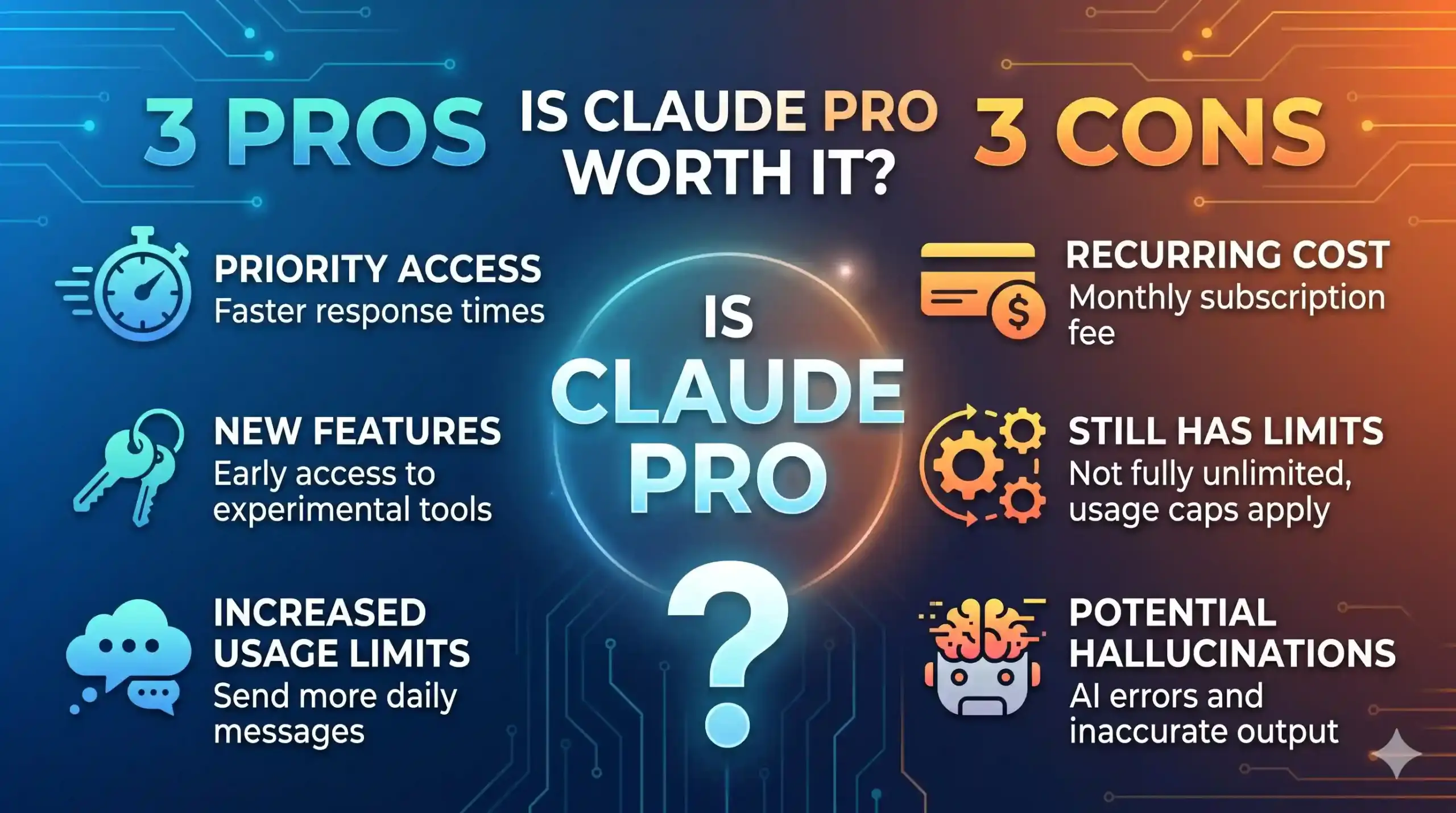
To clear up any doubts, our team thoroughly tested the service. Below, we break down the top three advantages and three disadvantages of the paid version. Spoiler alert: for heavy users and working professionals, the upgrade makes a substantial difference in daily workflows.
Priced at standard premium AI rates (typically around $20 per month globally), Anthropic states that the Pro package is designed for complex, demanding tasks like deep research, project organization, and advanced code generation. Let’s dive into the main pros and cons to help you decide if this investment aligns with your usage profile.
The Top 3 Advantages of Claude Pro
1. A Massive Increase in Usage Capacity
The most immediate benefit of the Claude Pro plan is the expanded usability. In the free version, it is incredibly common to hit an interaction limit when handling complex tasks, resulting in a temporary lockout until a certain time.
During our heavy-use testing over several days, the difference was night and day. With the paid plan, we were able to hold extensive, long-form conversations, seamlessly switch between distinct tasks, and rely on the AI throughout the entire workday without frustrating interruptions.
Claude operates using “tokens”—units that measure the processing power consumed in each prompt. The longer and more complex the conversation, the higher the token spend. Claude Pro offers a significantly wider token limit, enabling continuous, robust usage that the free tier simply cannot match.
2. Exclusive Access to the Opus Model
The Pro subscription unlocks access to Opus, Anthropic’s top-tier, flagship model within the Claude 3 family. While the freely available Sonnet model is excellent, the difference is glaring when tackling complex, multi-step reasoning.
When we asked Opus to analyze massive, multi-page documents, the responses were remarkably more precise, structured, and insightful than those provided by Sonnet. For drafting simple emails or basic texts, the difference might not be immediately obvious. However, for demanding, analytical workloads, Opus delivers a noticeably superior level of quality.
3. Priority Access During Peak Traffic
Free users frequently experience temporary blocks during peak traffic hours—typically mornings and early afternoons—when the platform is flooded with requests.
With Claude Pro, your access is guaranteed, even when the servers are under heavy load. For professionals working against strict deadlines or those who rely on their AI assistant at specific times of the day, this reliability is a major differentiator. It is important to note that this isn’t necessarily about faster typing speeds, but rather guaranteed availability. Simply put: the Pro plan won’t leave you waiting in a digital line when you need it most.
The Top 3 Disadvantages of Claude Pro
1. Usage is Still Not “Unlimited”
Despite offering a vastly larger token allowance, Claude Pro is not truly unlimited. Your usage limits are refreshed periodically (usually every few hours), and there is an overall consumption ceiling.
For the vast majority of users, this cap is more than enough. However, power users pushing the Opus model to its absolute limits will eventually encounter blocks. Because the Opus model is so advanced, it consumes significantly more quota per message than the Sonnet model. If you use it to process massive volumes of text in rapid succession, you can still hit your session limit before the workday ends.
2. Advanced Features are Niche and Require a Desktop App
Claude Pro grants access to specialized features like Claude Code (aimed directly at programmers) and desktop automation tools designed to organize local files and workflows.
While powerful, these features are highly targeted toward specific technical profiles, such as developers and automation engineers. If you are a general user who only interacts with AI via a web browser chat, these tools won’t add much value to your daily routine. Furthermore, utilizing these advanced tools requires installing the dedicated desktop application on a PC or Mac. They are not available via the web browser, which can be a dealbreaker for users who constantly switch devices or prefer not to install standalone software.
3. No Image Generation Capabilities
This is a structural limitation of Anthropic’s platform: Claude does not generate images, neither on the free tier nor on the Pro plan.
While direct competitors like ChatGPT and Google Gemini offer integrated image generation—and significantly enhance those visual features on their paid tiers—Claude remains strictly a text-based tool. Even their interface-prototyping feature, Claude Design, does not produce standalone illustrations or photos. If your workflow requires an all-in-one assistant capable of handling both text and visual media, Claude Pro falls short of the competition.
The Final Verdict: Should You Upgrade?
Yes, but only if you fit a specific usage profile.
Claude Pro is a fantastic investment for professionals who rely on AI heavily throughout the day. If you are a journalist, copywriter, data analyst, programmer, or digital marketer, the massive increase in generation capacity is absolutely real and highly practical. It delivers the heavy-lifting power required for intense text processing, deep analysis, and complex reasoning.
On the other hand, if you only use AI sporadically for quick Google-style queries, basic email drafting, or if you desperately need AI image generation, the $20 monthly fee will be wasted on capacity you won’t use. For light-to-moderate needs, the free plan is more than capable of getting the job done.